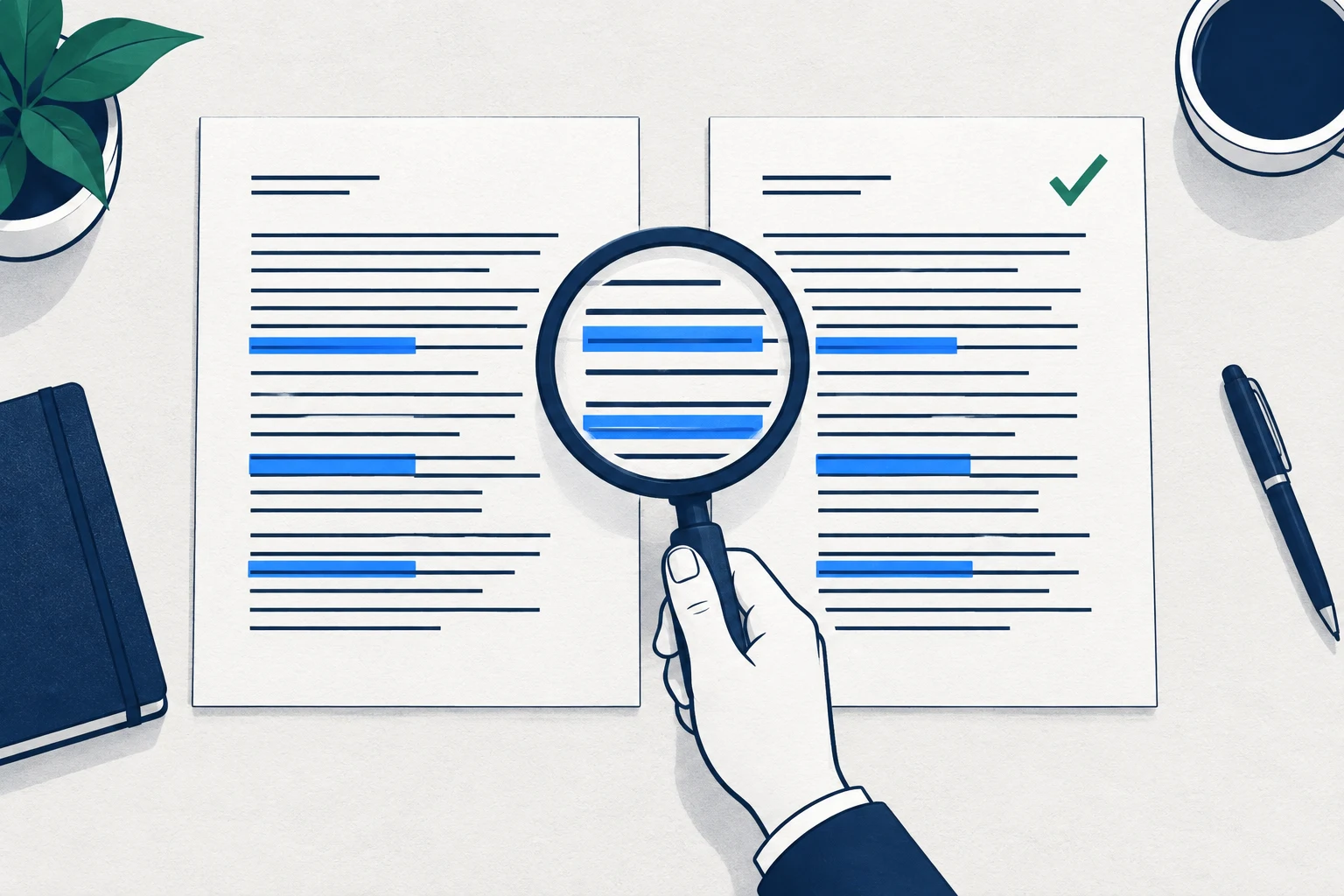
To fact-check AI-generated content, start with the claim rather than the confidence of the wording. A hypothetical draft might say that most UK retailers use conversational software to manage suppliers. Before publishing, you need a source that actually studied those retailers and that use case. A link about online shoppers would not support it.
NIST AI 600-1 describes confabulation as generative AI presenting erroneous or false content confidently (NIST). For an editor, the practical response is to inspect the supporting passage, compare its scope with the draft, and record what needs correcting or removing.
This guide shows how I approach that work in Content Updater: separate search attribution from editorial review, choose sources suited to the claim, and maintain a claim ledger. The worked example is hypothetical; the application observations come from testing its research workflow.
Key takeaways
- Generative models produce grammatically fluent text that can conceal confabulation, requiring human editors to inspect primary evidence before publication.
- Grounding metadata provides technical attribution to retrieved web chunks, but an editor must independently verify whether the cited passage supports the draft assertion.
- Source quality is claim-dependent, meaning vendor documentation supports product specifications but does not prove commercial outcomes or industry adoption.
- Log every checkable assertion in a claim ledger to compare scope, geography, and baseline context against the exact primary passage.
Why search relevance differs from factual accuracy
Search relevance tells you that a document concerns a topic. Verification asks a narrower question: does the cited passage support this exact sentence?
Google Cloud documents groundingChunks as source information for retrieved results, including web URIs and titles (Google Cloud). It documents groundingSupports as mappings from generated text to relevant grounding chunks (Google Cloud). These fields provide attribution. I treat them as a way to locate evidence, then inspect the original passage separately.
That distinction became concrete while I tested Content Updater. Vertex AI returned source metadata alongside generated text, but an initial rule in my application could attach material from another URL on the same domain. I corrected the matching to use the exact source URL and its attribution spans. This was a defect in my application, not evidence of a fault in Vertex AI.
I also separated search-matched evidence from editor-reviewed evidence in the interface. A search match does not mark a claim as reviewed. To record a review, I inspect the original document and save the supporting passage. This gives the next editor a traceable starting point, while leaving the judgement about whether the evidence supports the claim with the editor.
Framework for AI content source verification
A dependable framework for AI content source verification is an editorial decision-making sequence that isolates individual claims and tests them against primary records. Rather than reviewing a draft as continuous prose, you evaluate standalone assertions to determine whether they meet professional publication standards.
My recommended working method relies on four key editorial decisions:
- Decide what requires verification: Separate checkable factual assertions from subjective opinion and stylistic phrasing. Any statement alleging an operational capability, legal rule, historical event, or market trend requires independent corroboration before you approve it.
- Distinguish vendor documentation from independent findings: Determine the evidentiary capacity of the cited source. A company announcement or official product manual provides authoritative evidence for product features, system parameters, and published pricing. That same announcement cannot serve as independent verification of customer productivity, cost reductions, or broader industry adoption.
- Evaluate passage alignment: Determine whether the cited primary text explicitly supports the draft claim. An authentic document can still be cited out of context, or its findings may have been reversed by subsequent updates. You must inspect the version and claim scope rather than assuming a primary document is permanently accurate.
- Determine the editorial status: Assign each claim a clear status: supported, corrected, unsupported, or unresolved. If a statement lacks primary evidence or contradicts the source, decide whether to rewrite the sentence to reflect the verified record or delete the assertion entirely.
Use this framework to distinguish commercial marketing claims from independently supported findings. It establishes clear boundaries between what a vendor says about its own software and what independent research demonstrates in practice.
Source quality hierarchy for B2B editorial teams
Source quality depends on the specific claim you need to substantiate rather than a universal prestige score. A source that provides reliable evidence for one type of assertion can be entirely unsuited to another. For example, an official engineering specification provides valid evidence for an API parameter, but it cannot substantiate claims about customer satisfaction or commercial return on investment.
When you evaluate reference material, classify each document by its claim-dependent characteristics:
| Source Type | Representative Examples | Appropriate Use | Editorial Limitations |
|---|---|---|---|
| Primary technical documentation | API references, product manuals, system specifications | Verifying feature availability, interface settings, and documented technical limits. | Does not substantiate customer satisfaction, commercial ROI, or market-wide adoption. Primary manuals can also contain outdated version details. |
| Original empirical research | Peer-reviewed papers, national statistical releases, audit reports | Corroborating measured findings, methodological datasets, and observed trends. | Findings reflect specific sample sizes, geographic boundaries, and collection periods that may not match your draft. |
| Secondary reporting and analysis | Industry trade journalism, investigative news features, analyst overviews | Providing context, industry perspectives, and qualitative commentary. | Can introduce reporting bias, oversimplify technical nuances, or uncritically repeat third-party claims. |
| Unsourced summaries | AI-generated roundups, uncredited aggregator articles, marketing listicles | Initial background orientation and subject exploration. | Cannot corroborate factual assertions, substantiate claims, or serve as acceptable editorial attribution. |
Even a primary source can be wrong, outdated, or superseded by later revisions. When you review technical assertions, examine the document date, publication version, and methodological scope before accepting its conclusions.
Step-by-step process to fact-check AI-generated content
To fact-check AI-generated content, you must execute a systematic review that tests every substantive claim against an authentic primary record. While an editorial framework guides your evaluation decisions, this step-by-step process outlines the physical actions required to verify a draft before publication.
Follow these practical steps for every AI-assisted draft:
- Isolate checkable assertions: Read through the draft and extract every concrete statement into an editorial review file. Highlight product specifications, technical configurations, regulatory references, and direct quotations. Treat each extracted statement as an unproven claim.
- Locate the primary document: Follow reference links back to the original publisher rather than stopping at secondary blogs or aggregator summaries. A source link is a starting point, not proof that a claim is correct. If the draft cites a secondary article, trace the citation until you reach the originating organisation, dataset, or technical manual.
- Search for the exact passage: Open the primary record and locate the specific paragraph, table, or footnote where the subject is addressed. Never rely on the webpage title, executive summary, or meta description. Read the full passage to confirm that the text directly discusses the claim in your draft.
- Audit context and scope: Compare the wording in your draft against the source text across five core parameters:
- Geography and population: Check whether a study examining North American consumers has been mistakenly applied to UK business enterprises.
- Baseline and timeframes: Verify whether the finding describes an ongoing standard or an experimental trial that concluded years ago.
- Units and metrics: Check whether qualitative feedback has been converted into quantitative assertions, or whether currencies and totals have been altered.
- Denominators: Ensure any comparative statements reference the correct base group rather than an unrepresentative subgroup.
- Uncertainty and caveats: Confirm whether the original authors included warnings or limitations that the generative model omitted.
- Log the outcome and revise the draft: Record whether the statement is supported, corrected, unsupported, or unresolved. If the primary text contradicts the claim, or if no primary source exists, rewrite the sentence to match the verified evidence or remove the assertion from the article.
Claim ledger template and worked example
A structured claim ledger provides a transparent audit trail that records each assertion alongside its primary passage and editorial outcome. Recording the checks makes unresolved claims visible before publication.
You can maintain this workflow using a simple plain-text template in your editorial notes:
Claim in draft: [Insert original AI-generated statement]
Primary passage: [Paste exact quotation from inspected primary document]
Date and scope: [Record publication date, version, geography, and sample]
Editorial decision: [Supported / Corrected / Unsupported / Unresolved]
Action taken: [Record text revision or deletion]
The draft claim and source passage below are both invented for this teaching example. The table illustrates a consumer-versus-business scope mismatch.
| Claim in Draft | Primary Passage Located | Date and Scope | Decision | Correction |
|---|---|---|---|---|
| Hypothetical draft claim: "Independent retailers across the United Kingdom rely on generative AI tools to manage daily inventory schedules." | Hypothetical primary passage: "In our qualitative survey of individual online shoppers across North America, participants reported using conversational AI tools to find personal gift ideas." | Illustrative survey period; a hypothetical qualitative study of individual North American online consumers, not UK retail business inventory systems. | Unsupported for retail businesses; corrected to match the source. | Revised draft: "In a survey of North American online shoppers, participants reported using conversational AI tools to find personal gift ideas." Alternatively, if the article specifically addresses retail inventory operations, remove the sentence entirely because the source does not examine business logistics. |
In this hypothetical example, the generative model introduced a severe scope mismatch by conflating personal consumer gift searches with commercial inventory operations in a completely different country. The draft presented the statement with total linguistic confidence, yet the primary document examined an entirely different audience.
Notice how the editorial correction strictly respects the evidence. The revised text does not invent substitute claims about UK retailers taking a cautious approach or preferring manual processes. If an article focuses exclusively on business logistics and the source only covers consumer shopping, the most rigorous editorial choice is to delete the claim. Every part of a corrected sentence must follow directly and solely from the inspected primary document.
Editorial verification checklist for publishing
Use a final checklist to make unresolved source questions visible before publication. Completing it supports a consistent review, but does not guarantee that every error has been caught.
Complete these checks before releasing any AI-assisted draft:
- Primary passage alignment: Every factual statement, technical parameter, and data point corresponds directly to an inspected passage in an authentic primary document.
- Direct quotation integrity: Every quoted statement matches the exact wording in the primary record without synthetic paraphrasing or omitted qualifying clauses.
- Date currency and version checks: Technical documentation, pricing schedules, and survey data reflect current active versions rather than outdated releases.
- Audience and geographic scope: Findings gathered from specific user groups or overseas markets are not extrapolated to unstudied commercial sectors.
- Commercial disclosures: Disclose relevant affiliate links, commercial partnerships or other relationships; a neutral mention of a vendor is not itself a commercial relationship.
- Ledger completion: The claim ledger contains a definitive status for each highlighted statement, leaving no unresolved queries in the draft.
Embedding this verification routine into your wider AI content automation workflow gives source review a defined place alongside drafting and production. Quality gates function best when they are integrated into regular production milestones, allowing writers and editors to spot unsupported claims before copy reaches staging environments.
Start with your next draft: copy the plain-text ledger template into your editorial notes, extract three key factual claims, and verify their primary passages before approving the article for publication.
Frequently asked questions
Can you trust citations provided by generative AI?
No, you cannot accept citations from generative AI without checking the primary source yourself. Generative models can confabulate plausible references, presenting erroneous content with high confidence (NIST). While platforms provide grounding metadata linking generated text to retrieved chunks (Google Cloud) and citation mappings (Google Cloud), this indicates technical attribution rather than factual truth. An editor must inspect the original passage to verify that it substantiates the claim.