You may be interested in AI and still struggle to answer a practical question: where should our team start?
A sales director sees hours spent on follow-up. Finance sees repeated invoice checks. Talent sees time spent assembling candidate information. Each problem sounds like an automation opportunity. Choosing the right change requires a closer look at the work, the alternatives and the consequences.
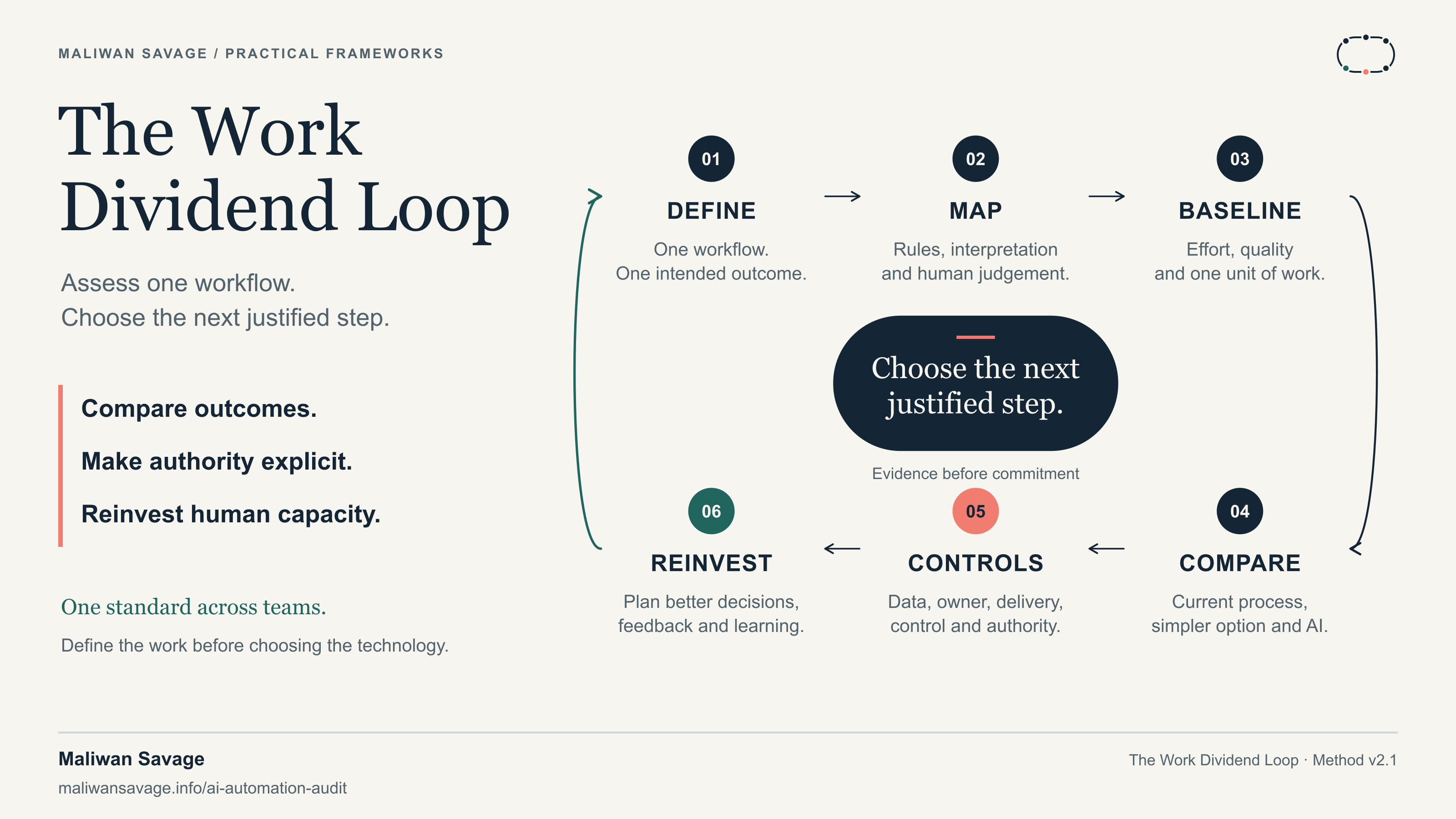
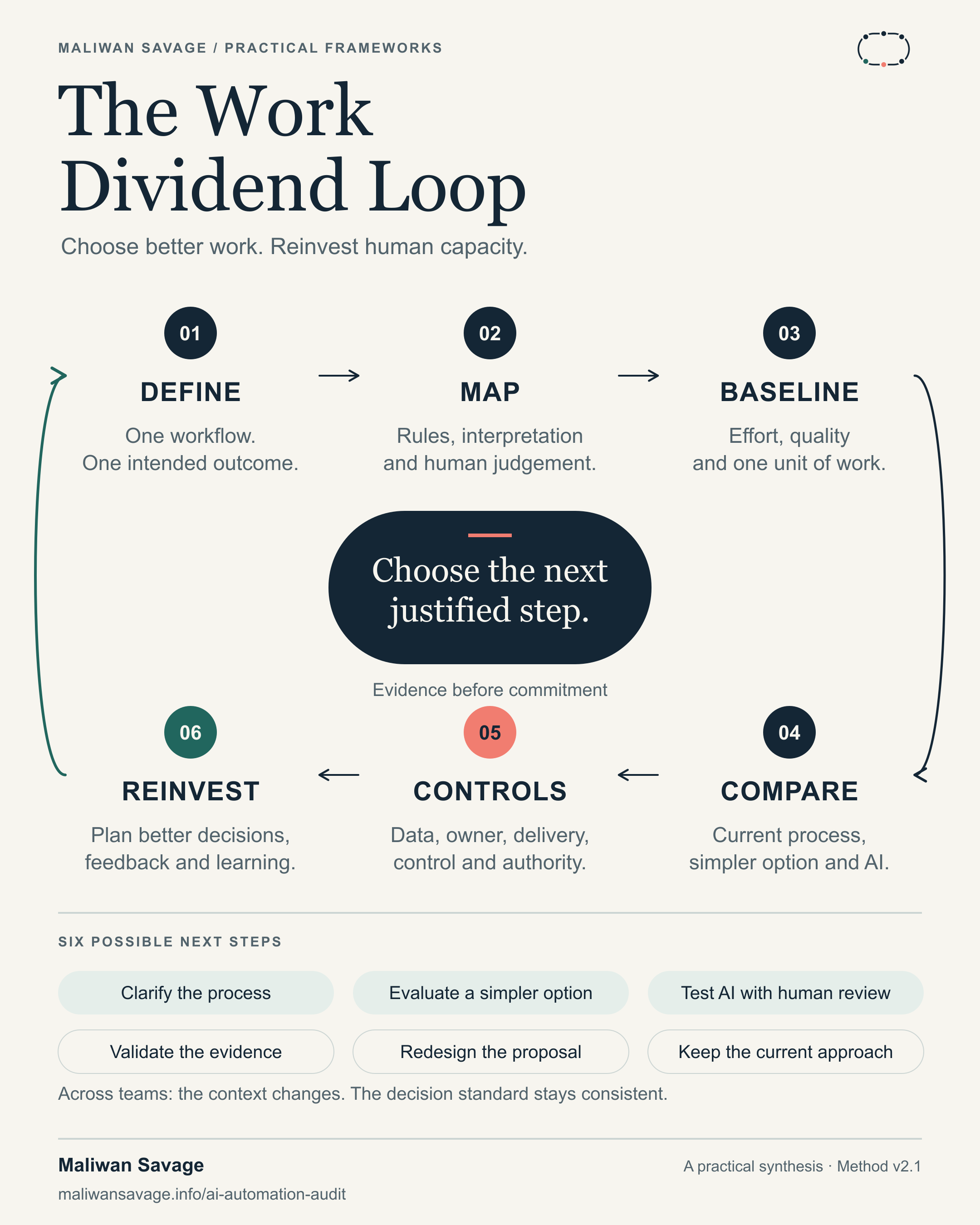
I developed The Work Dividend Loop to give that conversation a clear structure. It is a six-step method for assessing one workflow, choosing the next justified action and planning how any released human capacity could improve the way a team operates.
The executive version
- Choose one workflow and one outcome you want to improve.
- Compare the current process, a simpler option and AI using the same cases.
- Check quality, total effort and who has authority to act.
- Decide what to test, clarify, redesign or keep.
- Plan how people will use any time released, and measure whether outcomes improve.
Try the free Workflow Opportunity Diagnostic, or read on to see the method and its limits.
What is the Work Dividend Loop?
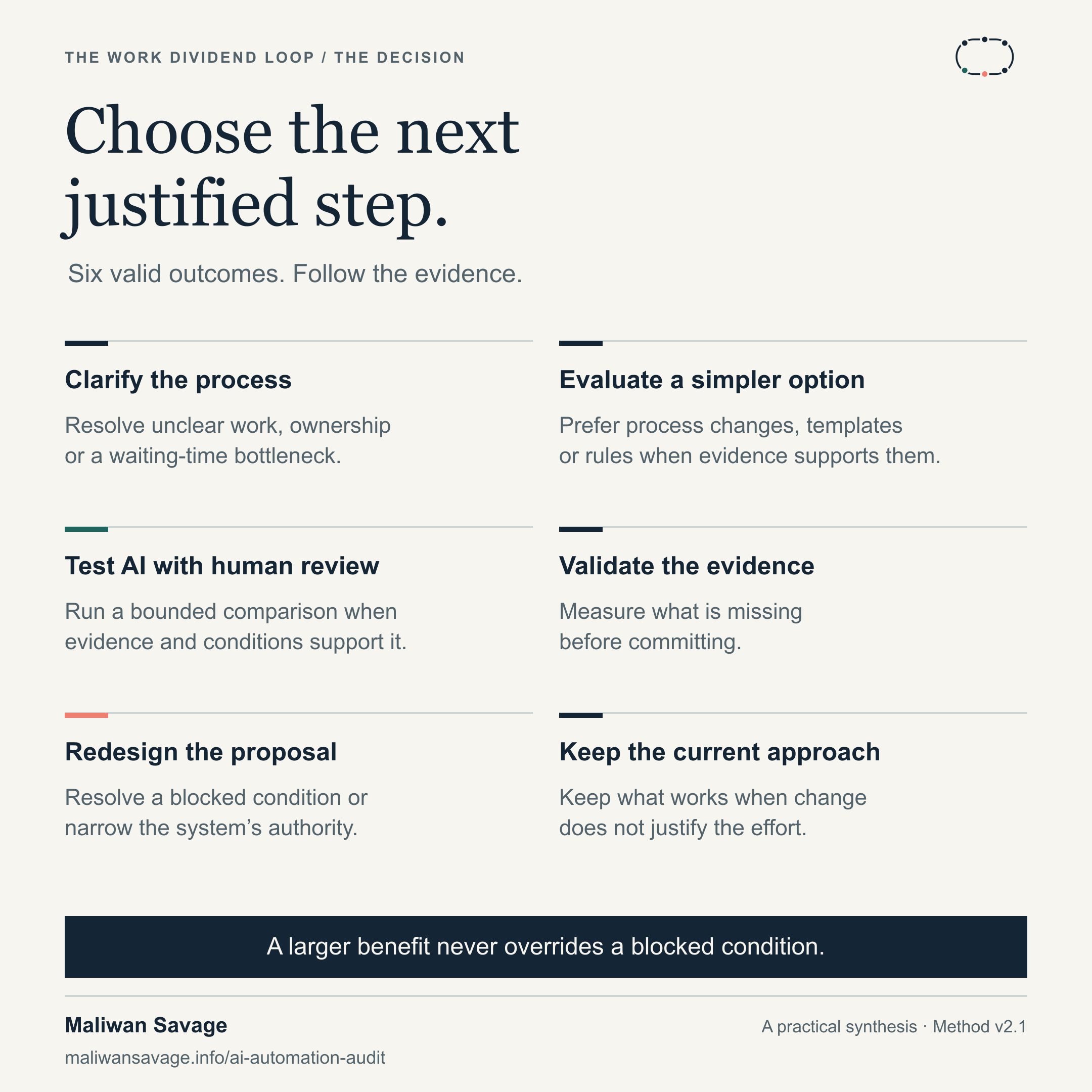
The six steps are Define, Map, Baseline, Compare, Controls and Reinvest. Together, they produce a short decision brief: the problem, the options, the evidence, the conditions for proceeding and the next useful test.
The word dividend describes the value that can come back from better work. That could mean fewer mistakes, better service, more time for difficult decisions or a stronger feedback loop. Released time is one possible benefit. It becomes valuable when someone makes a deliberate choice about how to use it.
The method underpins my Workflow Opportunity Diagnostic and develops the approach in AI Opportunity Assessment Before You Build. It is my practical synthesis of established ideas and lessons from building and testing the tool. It is not a certified standard, and I have not established that using it causes better business results.
It can also support an improvement whose main purpose is quality or service rather than capacity. In that case, the chosen outcome takes priority, and the team must judge whether any additional effort or cost is worthwhile.
Why use this alongside established frameworks?
There are already useful ways to improve work, prioritise investment and manage AI risk. I use them for the questions they were designed to answer. The comparison below is my interpretation of how they can fit together, rather than a ranking of which framework is best.
| Approach | Where it helps | How I would use it with this loop |
|---|---|---|
| Lean thinking | Understand customer value, the work and the people doing it; improve quality and flow through learning. | Use it to question unnecessary steps and handovers. If the problem is poor flow or unclear work, begin there before choosing technology. |
| DMAIC | Define, Measure, Analyse, Improve and Control: a structured approach to improving an existing process. | Use its deeper measurement and root-cause methods when recurring defects or process variation need investigation. The loop can frame an initial conversation; it does not replace that analysis. |
| RICE | Compare project priorities using reach, impact, confidence and effort. | Use it across a portfolio once the opportunities and assumptions are reasonably comparable. Keep permission and unacceptable consequences as separate decisions. |
| NIST AI Risk Management Framework (AI RMF 1.0) | Organise ongoing AI risk management through Govern, Map, Measure and Manage. | Use it to deepen governance, evaluation and monitoring. Its functions are interconnected, with governance running throughout; they are not four mandatory sequential steps. |
I chose this six-step structure for an early executive discussion because it keeps four decisions together: what outcome matters, whether a simpler option is sufficient, what the system may do and where human capacity would go. The result is a proposed next commitment that a workflow owner can examine.
These ideas have established roots. Lean already places value, people and learning at the centre of improvement. My contribution is a way to bring the questions into one practical workflow assessment and make the reasoning visible. A team with a strong improvement or governance programme should connect this exercise to that programme.
1. Define: choose one workflow and one intended outcome
Start with a piece of work that has a clear beginning and an accepted end. “Automate finance” is too broad. “Check a contractor invoice against approved hours and agreed rates before a finance reviewer approves it” gives the team something concrete to investigate.
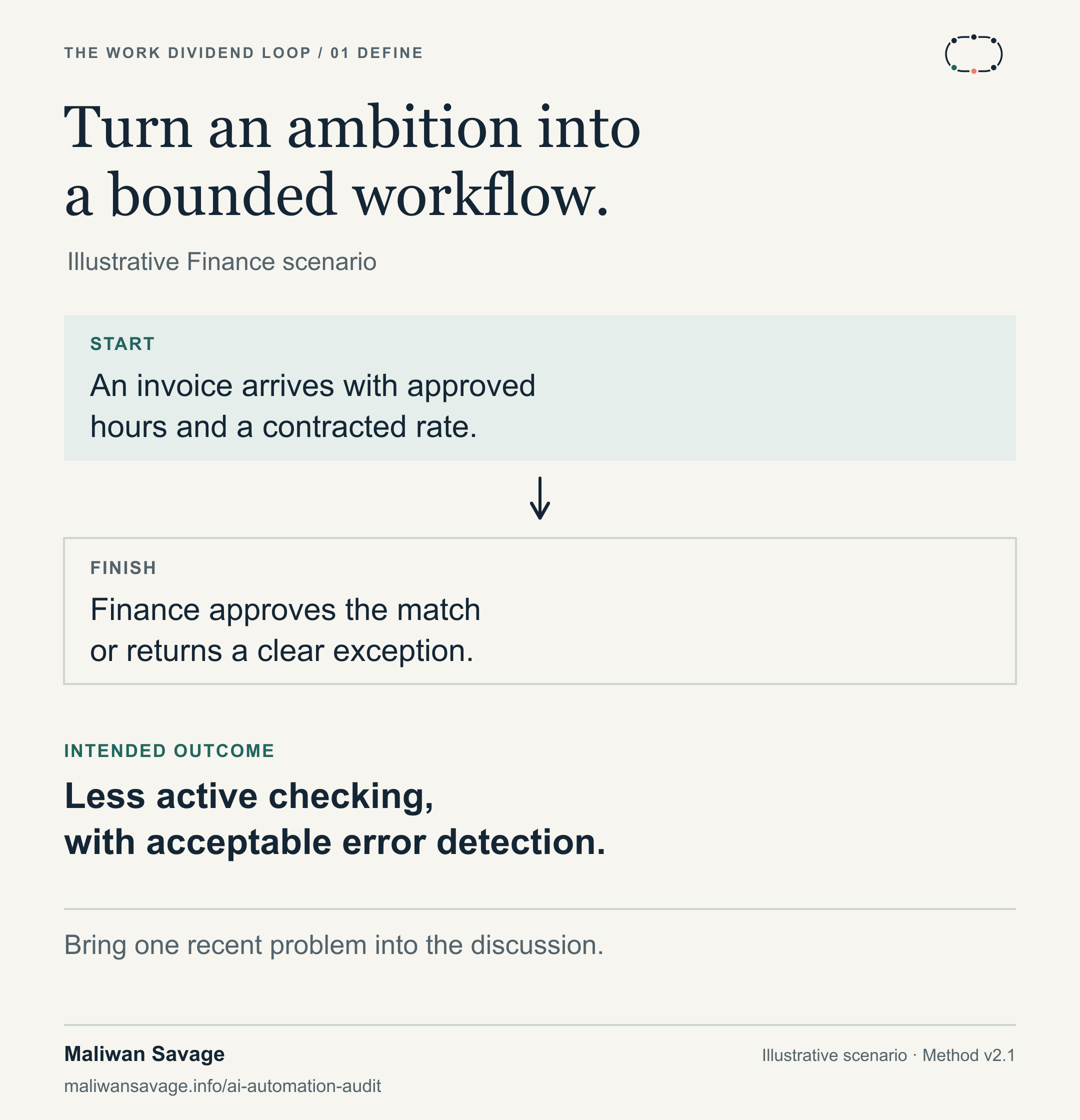
Ask what happened the last time the work caused a problem. Was information missing? Did someone copy the same data twice? Did an approval wait in a queue? A recent example often reveals more than a general statement that the team is busy.
Then name the main outcome. You might want to reduce active checking time while protecting accuracy, improve the quality of evidence available to a decision-maker, or shorten the time a customer waits.
Example: if a monthly report takes two days because nobody can confirm which ledger extract is final, faster AI-written commentary may leave the main delay untouched. Agreeing the source of truth and sign-off process could be the more useful first change.
What to record: the workflow, its start and finish, the people affected, the main friction, the intended outcome and an accountable owner.
2. Map: separate rules, interpretation and human judgement
Write down the steps people actually follow, including corrections and handovers. For each step, ask what kind of work it contains.
- Clear rules: checking a required field, matching an approved rate or routing an item using agreed criteria.
- Interpretation: finding relevant evidence in varied documents, drafting an explanation or summarising a conversation. AI may be worth testing here.
- Human judgement: approving a payment, deciding who progresses in recruitment or accepting a business risk.
- Unclear work: a step whose instructions or ownership need clarification.
A single workflow can contain all four. A sensible design might use ordinary software to validate inputs, AI to prepare a draft, a person to approve it and ordinary software to record the approved result.
Example: in Sales, checking whether a contact is suppressed follows rules. Drafting a relevant reply involves interpretation. Approving an unusual commercial promise requires an authorised person. Treating the whole sequence as one “AI task” hides those differences.
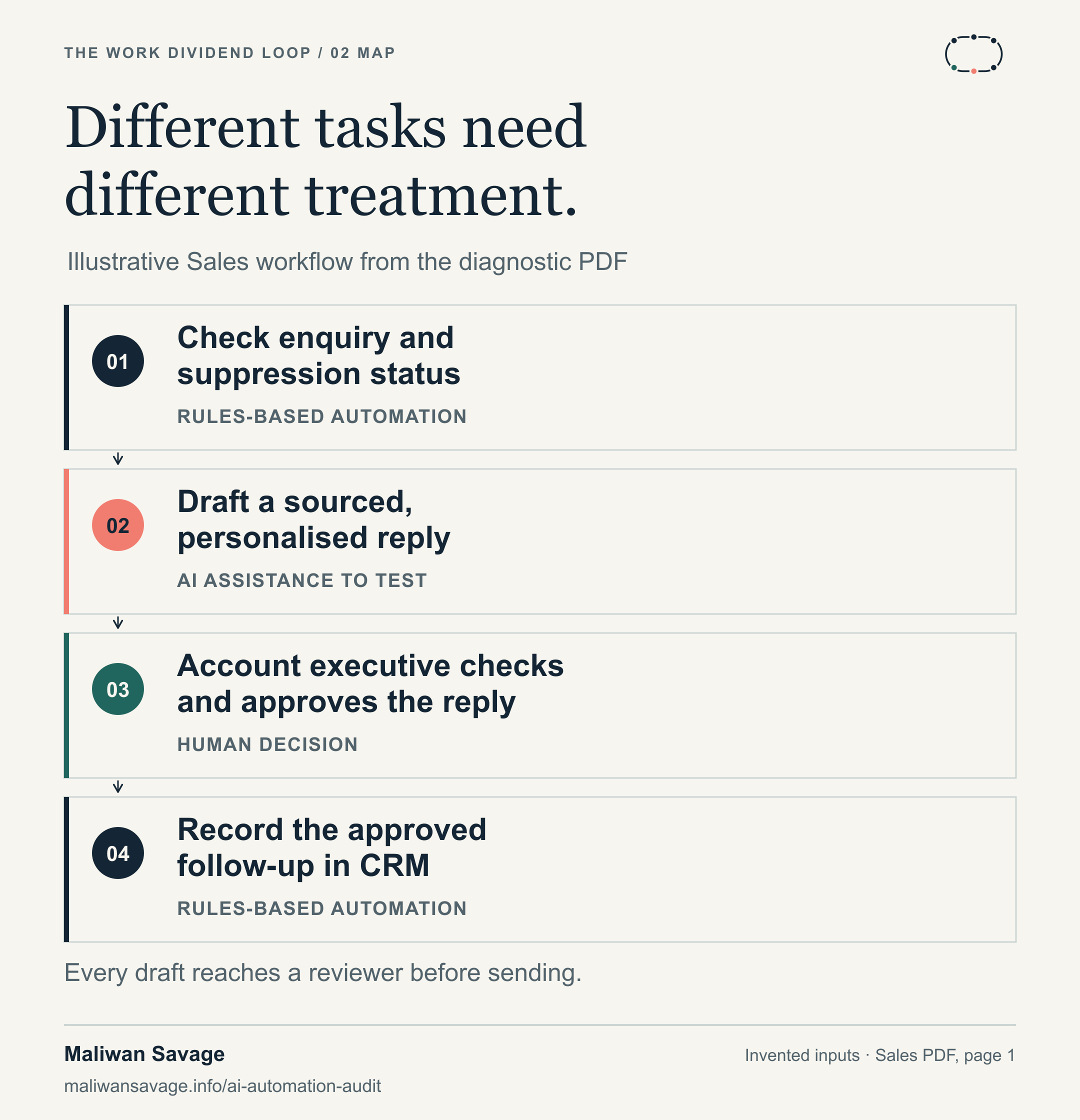
What to record: a short task map, who owns each handover and where information preparation ends and an operational decision begins.
3. Baseline: understand what happens today
A baseline is a description of current performance that someone can check. Choose one unit of work, such as an invoice, an enquiry or an approved design. Keep that unit consistent when comparing options.
Record the volume, active working time, review, corrections and outcome quality. Separate active work from waiting. A task that takes ten minutes of effort but waits three days for approval has two different problems.
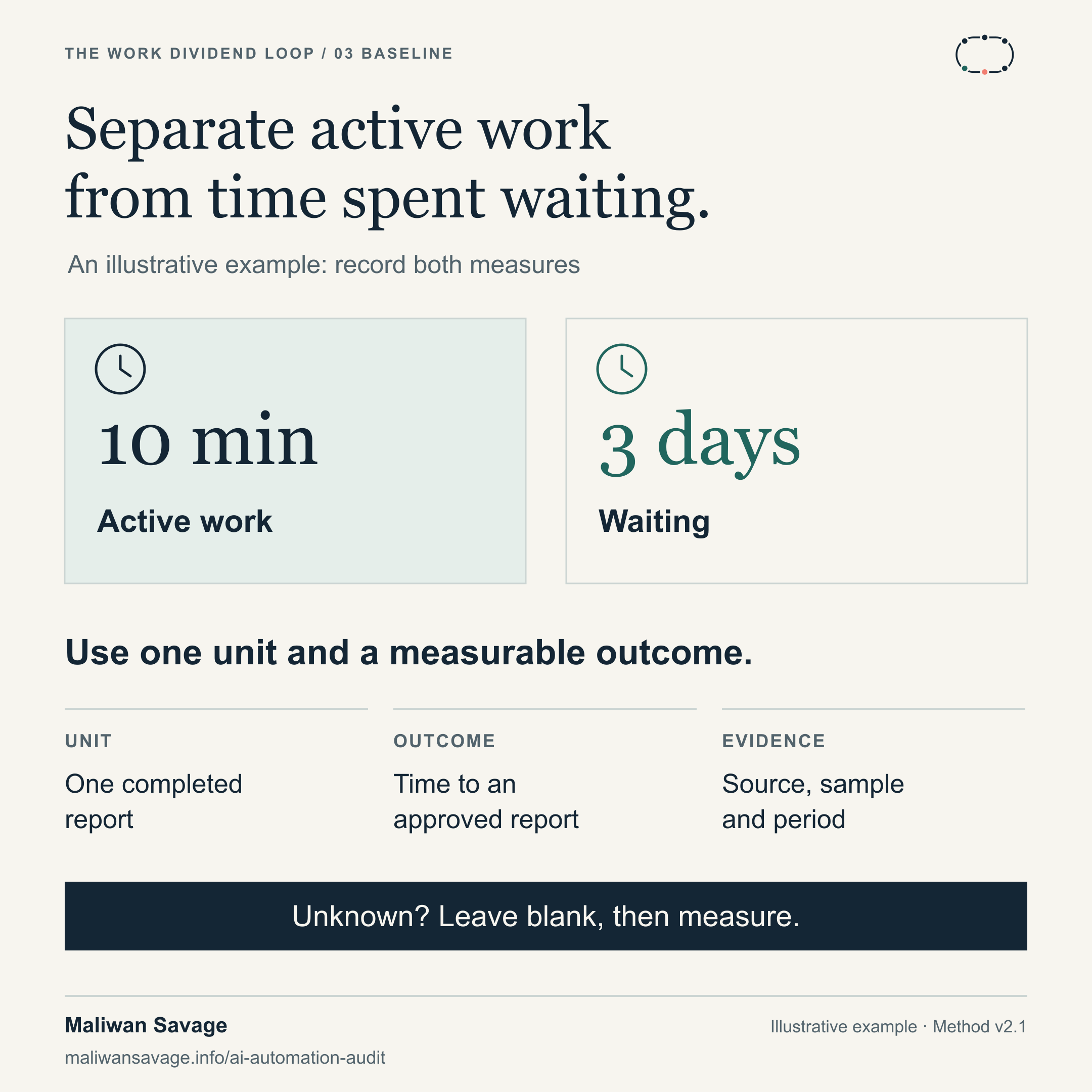
Choose a quality or service measure and an acceptable threshold before assessing the alternatives. That might be the proportion of material invoice mismatches detected, the share of designs accepted on first review, or elapsed hours to an approved customer response. Record where the figures come from, which period they cover and what remains unknown.
Example: a design team might require at least 85% first-pass acceptance against an agreed checklist. A proposed tool producing more variants has not established an improvement if too many variants fail that checklist.
A missing baseline is useful information. The next action may be to observe representative work rather than buy a tool. Include straightforward cases, exceptions and the people who spend time fixing mistakes.
What to record: one unit, representative demand, current effort, an outcome measure, an acceptable threshold and the source of the evidence.
4. Compare: give the simpler option a fair test
Compare three approaches where relevant: the current process, the best simpler improvement and an AI-assisted option. Simpler improvements include clearer instructions, a template, a shared data source, better search or rules-based automation.
Use comparable cases, the same outcome definition and a common review period. For outreach, avoid comparing one customer segment using templates with a different segment using AI and attributing every difference to the tool.
Count the work around the AI output: preparation, checking, expected rework and recurring upkeep. Record setup effort and financial costs separately, including software, model usage, integration, training and support.
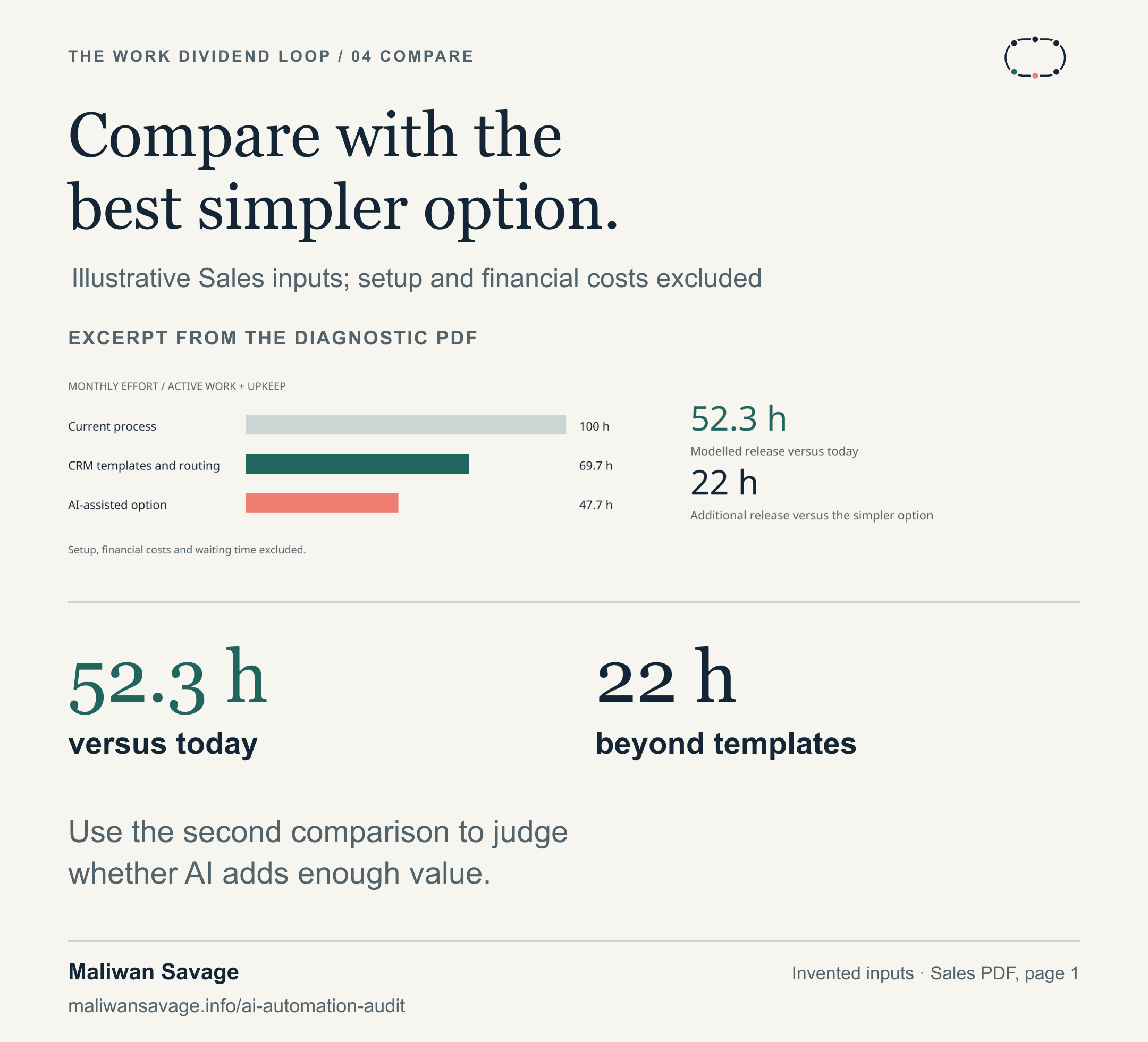
Illustrative Sales calculation: suppose 500 enquiries take 12 minutes each today: 100 hours a month. Templates take eight minutes each plus three hours of upkeep: about 69.7 hours. AI preparation, review and rework take five minutes each plus six hours of upkeep: about 47.7 hours.
The AI scenario releases about 52.3 hours against today, but only 22 additional hours against templates. That smaller difference is what the added complexity must justify. These are invented assumptions, before one-off setup and financial costs; they are not measured savings.
For a capacity objective, an option that misses the agreed quality threshold cannot win simply by being faster. For a quality or service objective, better outcomes may justify additional effort, subject to cost, controls and evidence. Test a realistic range for uncertain review time: a small change can reverse the preference.
What to record: comparable outcome results, total recurring effort, setup and financial costs, evidence strength and the assumptions most likely to change the decision.
5. Controls: make authority and consequences explicit
These conditions apply from the start of the assessment; step five brings them together for a decision. Check permitted data use before collecting or sharing records.
Ask five questions before considering operational use:
- Permitted data use: are the proposed access and processing approved for this purpose?
- Accountability: who owns the outcome, exceptions and corrections?
- Delivery: can the team access the right records and maintain the change?
- Error control and recovery: how will failures be detected, escalated, paused and corrected?
- System authority: does the system prepare information, act after individual approval or act without approval for each case?
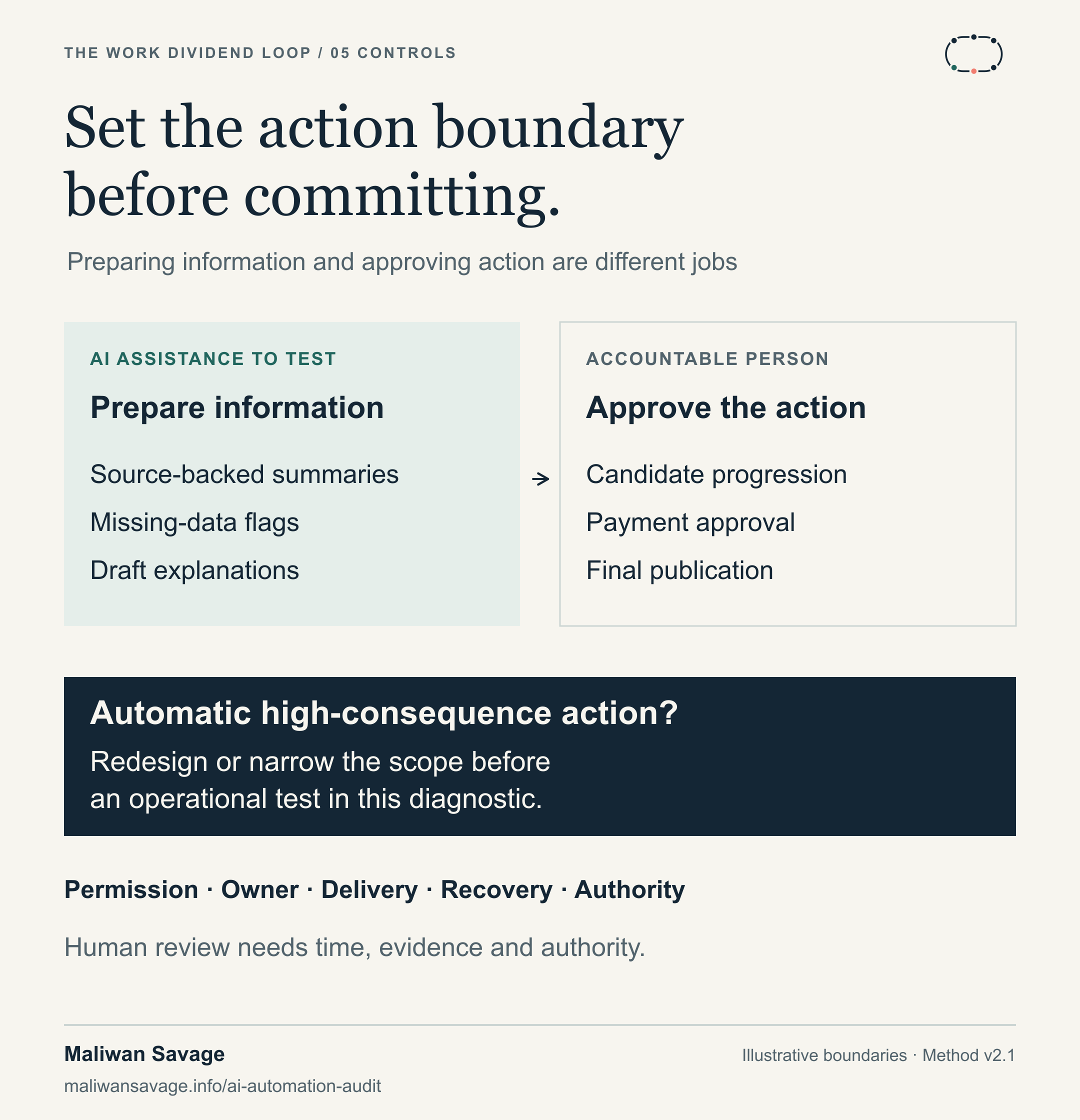
A large expected benefit does not resolve a blocked condition. Preparing an invoice exception summary and authorising a payment require different permissions and controls. So do summarising application evidence and excluding an applicant.
“Human review” needs an operating design: the reviewer must have the information, competence, time and authority to challenge the output. A person clicking through a queue without checking its contents is a weak control.
The diagnostic deliberately takes a conservative position on autonomous high-consequence actions: redesign or narrow the proposal before proceeding. That is a boundary of this tool, not a statement that every such system is technically impossible or that a reviewed design is automatically acceptable.
What to record: the permitted data, owner, reviewer, action boundary, failure cases, recovery method and conditions that would stop the test.
6. Reinvest: decide where human capacity should go
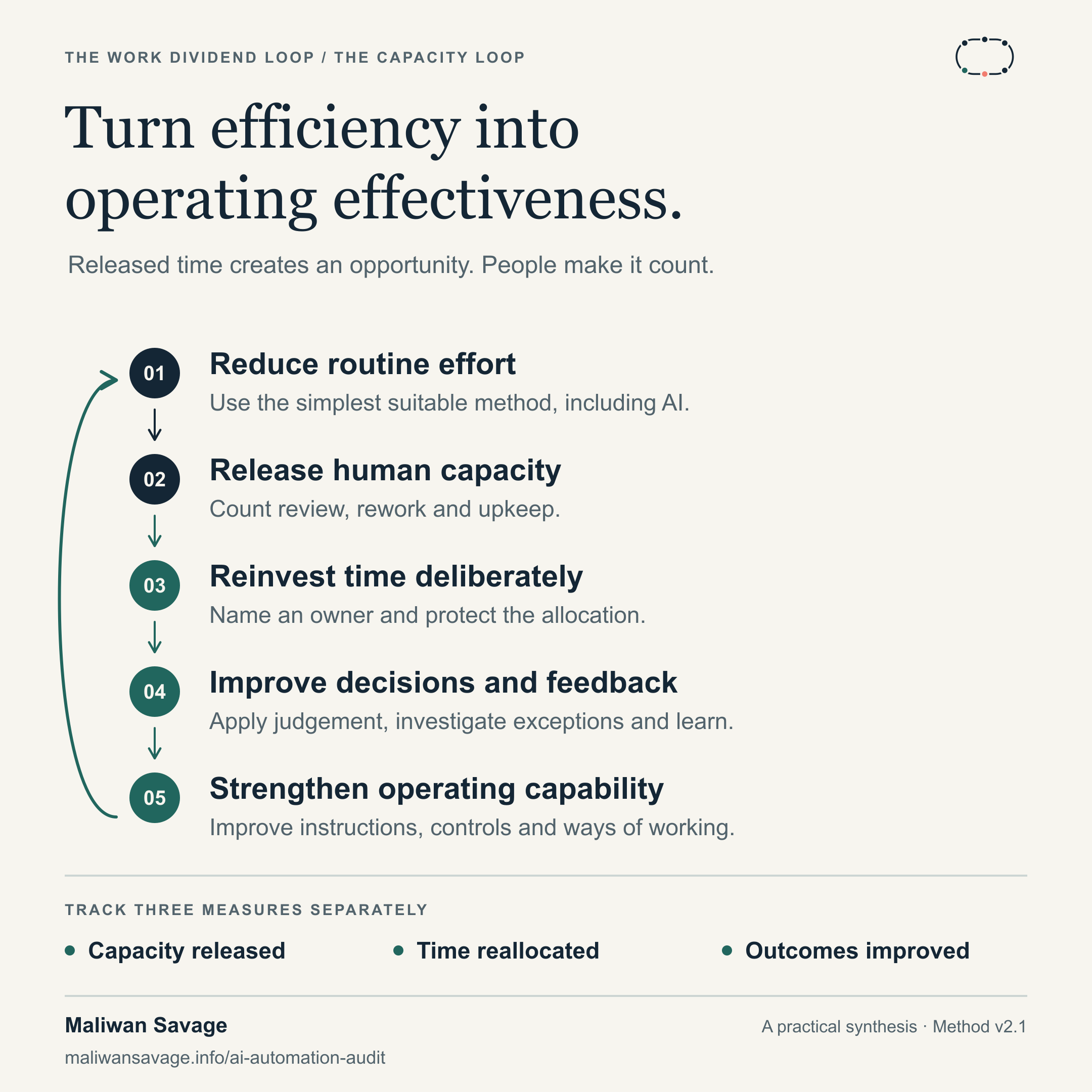
Efficiency means using less effort for an acceptable result. Effectiveness means achieving a better result. The link between the two is a management choice about how people use the time that becomes available.
In Finance, time could go into recurring supplier discrepancies and better exception rules. In Sales, it could support discovery conversations and feedback on common objections. In Talent, it could support candidate conversations and clearer role criteria. In Web, it could support user research, accessibility and the design system.
Write down the activity, its owner, the proposed allocation and the outcome to improve. For example: “The finance operations lead will protect a weekly review of recurring mismatches, with actions tracked and repeat issues measured over the next reporting periods.”
Track capacity released, time actually reallocated and outcomes improved separately. A modelled saving can disappear into fragmented minutes, a busier queue or additional checking. Unchanged payroll is not a cash saving, and time allocated to improvement is not a second saving.
What to record: a contingent reinvestment plan, an owner, a feasible allocation and a measure of whether the operating outcome improves.
How the same questions translate across departments
All scenarios and figures in this article are illustrative. The Sales, Finance, Talent and Web cases informed synthetic testing of the diagnostic. The additional examples show how the questions could be applied; they are not claims of production deployments or client results.
Sales: personalised follow-up for permitted enquiries
Assess the path from an inbound enquiry to an approved response and CRM update. Compare templates with AI-prepared drafts. Check qualified replies, unsupported claims, duplicate contact and suppression status alongside total effort. A representative can approve each message while recurring objections feed back into better guidance. The relevant outcome is a useful conversation, rather than the number of messages generated. Explore the Sales example brief.
Finance: timesheet and invoice reconciliation
Match an invoice to approved hours and contracted rates, flag exceptions and send them to an independent reviewer. Exact matching may suit rules. AI could be tested for extracting information from varied documents or explaining exceptions, with those outputs checked against source records. Include changed rates, duplicates, missing approvals and period or currency mismatches.
In the invented Finance case, 1,200 invoices at nine minutes each use 180 hours a month. A simpler option averaging four minutes per invoice, including routine review, plus six hours of upkeep uses 86 hours: a modelled release of 94 hours. That result depends on the assumptions and acceptable error detection. Testing must examine missed errors and false alerts before anyone treats the capacity as available. Approval and payment remain separate. Explore the Finance example brief.
Finance: P&L reporting and commentary
Separate assembling reconciled figures from interpreting them. Controlled reporting rules should establish the period, categories, calculations and agreement with approved records. AI might draft commentary from those verified figures, with links back to its evidence. A finance owner should check unsupported explanations of why a variance occurred. Reaching an approved report sooner and reducing material commentary corrections are more meaningful measures than producing more pages.
Talent: source-backed candidate evidence
Test whether an assistant can organise role-relevant evidence for a recruiter. Keep the original evidence available and ensure every application reaches the appropriate human review. Challenge omissions, unsupported personal inferences and unequal treatment across equivalent evidence in different formats.
A good average traceability score does not establish fair selection. In the synthetic Talent case, the proposal included automatically excluding lower-ranked applicants. The appropriate next action was to redesign that scope, despite attractive effort estimates. Narrowing the proposal to evidence preparation creates a different assessment, with its own controls and tests. Explore the Talent example brief.
Web and design: approved campaign variants
Start with an approved brief and licensed assets; finish with a reviewed, publishable design. Compare reusable templates with AI-generated variants using the same brand, usability and accessibility checks. In the invented test, AI achieved 80% first-pass acceptance against an 85% floor, while templates achieved 88%. The faster AI option therefore failed the quality condition. Human time could be better spent improving the design system and testing difficult mobile layouts.
Content and marketing: refreshing an article
Define the accepted update, including source accuracy and editorial approval. Check structured requirements with rules, test AI for drafting or reconciling information, and retain an editor for judgement. Include contradictory sources and missing evidence. Measure accepted updates after corrections, not first drafts. Reinvesting time in stronger briefs and recurring feedback may improve the next cycle. My guide to AI content automation workflows examines the operating detail.
Customer support: preparing a case summary and reply
Use approved case information and a current knowledge base to prepare a suggested response. Compare it with existing macros and search. Test missing history, outdated guidance and unusual requests. Keep refunds, account changes and other consequential actions within explicitly approved authority. Useful measures include resolution quality, repeat contact and total handling effort. A faster first response may be a poor result if customers must return to correct it.
The common standard is the reasoning, not the units or thresholds. An invoice and a customer enquiry have different consequences. Do not rank departments by raw hours alone.
What stress-testing the diagnostic changed
Cross-team tests exposed a weakness in an earlier version of my tool. A synthetic Talent description included automatic exclusions, yet the recommendation still favoured a reviewed AI trial because generic control answers did not capture the contradiction.
I changed the questions and decision rules to make system authority explicit. I also made outcome thresholds, comparison evidence, a unit of work and bounded test scope part of the recommendation. The Web case checked that a faster option could lose when its quality missed the agreed floor.
Those tests helped improve the tool's logic and questions. They did not validate real hiring decisions, finance controls or operational savings. A useful framework should expose assumptions, including weaknesses in its own design, and change when the evidence calls for it.
What the framework cannot tell you
Its usefulness depends on the quality of the conversation and evidence. Keep these limits visible:
- Self-reported answers need checking. A respondent can overestimate time, choose a weak measure or misunderstand permission. The diagnostic cannot verify the underlying records.
- One metric is incomplete. Pair the main outcome with difficult cases and stop criteria. An average can hide serious errors or unequal treatment.
- A successful sample has limits. Small, convenient or unrepresentative samples can mislead. Include the variation the team encounters, and agree sufficient evidence with the relevant specialists.
- Models and workflows change. Recheck quality, costs, access and review effort when inputs, providers or operating conditions change.
- A brief is not investment or operational approval. Organisational policy, security, finance, legal and other specialist review may be needed for the particular proposal.
- Released capacity is not a complete business case. Include cash costs, adoption, setup, ongoing support, dependencies and opportunity cost before an investment decision.
The method is intended to structure discovery across teams. Broader operational trials and independent evaluation would be needed to establish how well it performs in different organisations. I would welcome evidence that changes the questions or the method.
Start with one conversation your team can act on
Bring the workflow owner, someone who does the work and someone responsible for its data or consequences into the discussion. Choose one recurring problem and walk through the six steps using real examples you are permitted to discuss.
Finish with an owner, a review date and a small decision to resolve. State which cases will be compared, what good looks like, what would make you stop and what evidence would change your view. If the numbers are unknown, agree how to measure them.
You can begin with the free six-step diagnostic. It produces a visual brief you can examine with colleagues. Estimates and unknowns are welcome; missing evidence should lead to a measurement plan rather than a confident pilot recommendation.
Download the portrait framework for a team discussion, or download the complete visual kit, including editable SVGs. You can also download the five section visuals and their editable SVGs. The methodology page explains the diagnostic's calculations, decision rules and privacy arrangements.
My aim is to help leaders make a clear first commitment: improve a specific piece of work, examine the evidence and give people a deliberate role in making the operation better.